Finish the story you keep meaning to write.
Every screenplay gets stuck somewhere. Chorum helps you find the direction, work the scene, and hear three independent reads on what the next draft needs. Scene by scene to FADE OUT.
Start writingDev's just standing there. Give him something to do with his hands.
Half an idea is enough. Three ways it could go. You choose.
The Long Night
One location, one night, a dawn deadline. The regulars crack him open, one wash at a time.
Everything Goes Wrong
The dryer eats the shirt. By 9 a.m. he has learned he was interviewing for the wrong life.
The Person He's Avoiding
He is not here for the shirt. He cannot go home. The interview becomes the B-story.
Your pages, your voice. Help when you want it.
Dev's just standing there. Give him something to do with his hands. Quarters, maybe. Counting them wrong.
MABEL: "Sit down. You're making me nervous." Flat on purpose. Beat it.
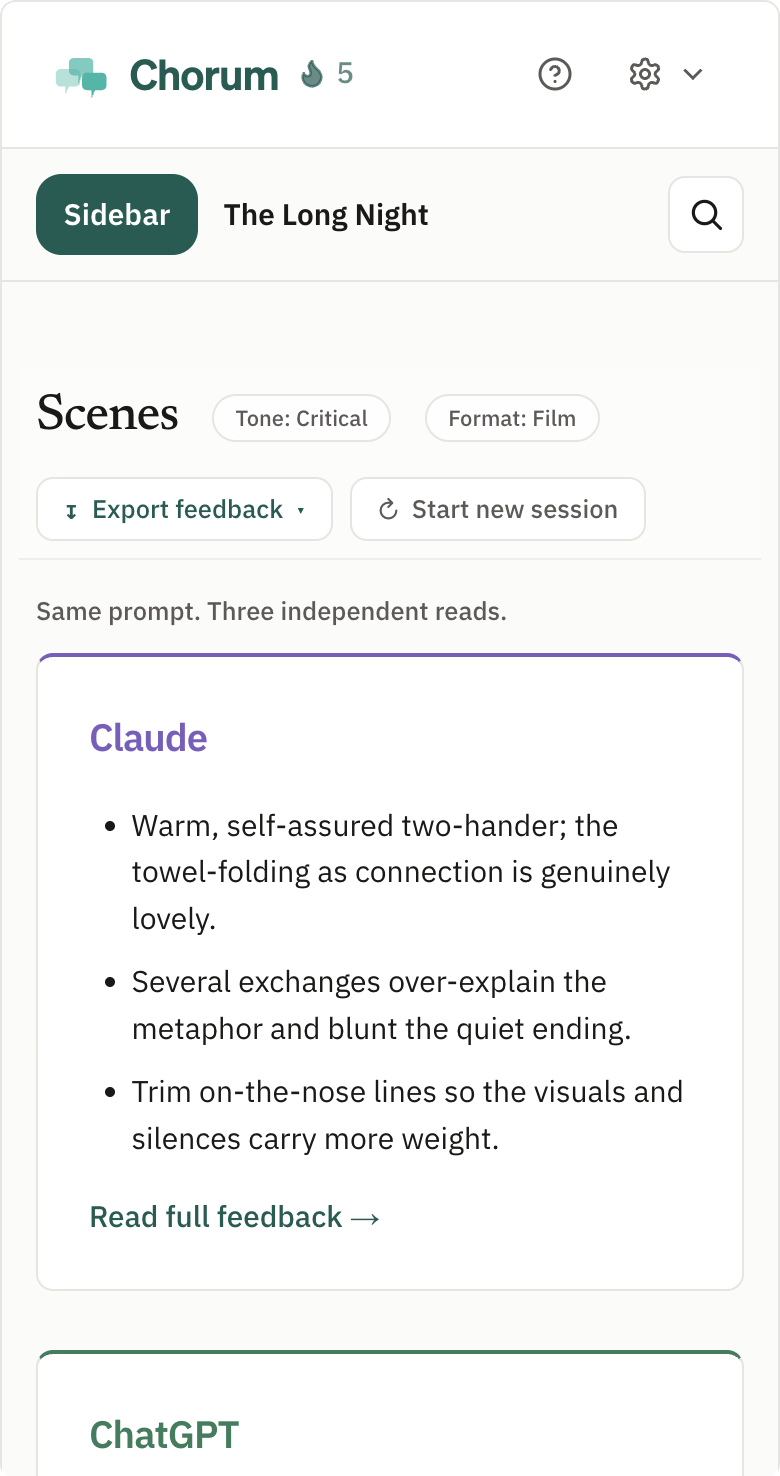
One line. Three minds.
"Then sit down. Nothing dries faster with an audience."
"Nothing dries faster with an audience" is the movie in one line. Protect it.
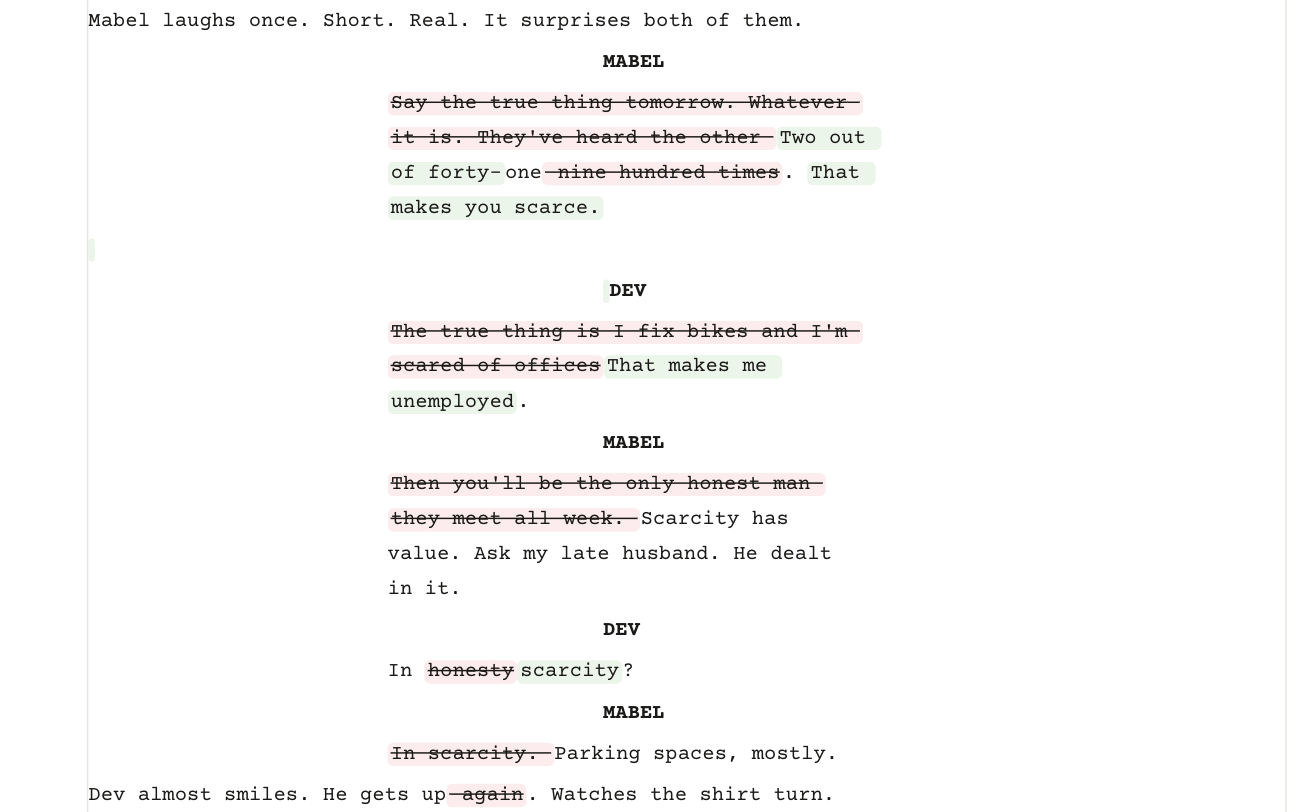
Cut "Then sit down." It's warm-up. The image lands harder alone.
Keep the warm-up. It's Mabel's patience running out. Cut it and she's just quippy.
You cut three words. The line lands harder.
"Nothing dries faster with an audience" is the movie in six words. "Then sit down" is throat-clearing. Cut it.
The readers split. The verdict chose a side. You made the cut. What stays is all yours.
FADE OUT is closer than you think.
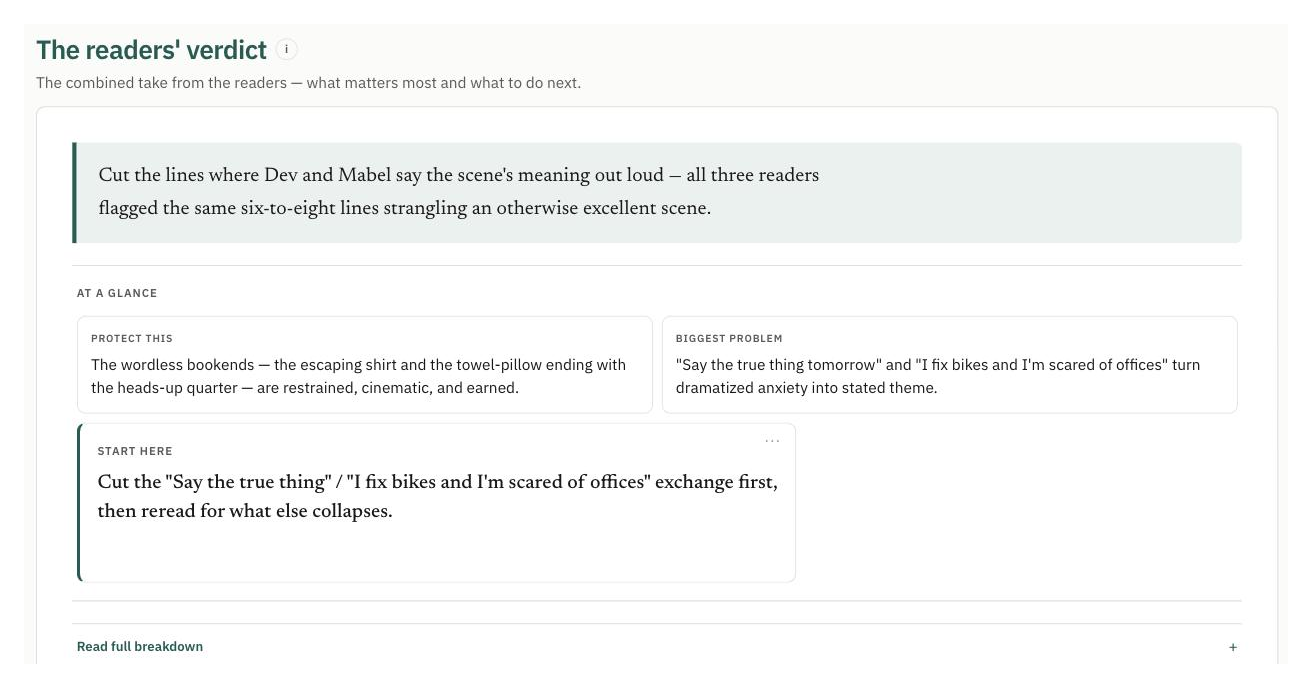
This is the verdict.
Straight answers.
Does the AI write my screenplay?
Chorum helps you write it. The readers propose directions, offer blocking help when a scene stalls, and sometimes hand you a deliberately flat line to beat. You decide every word that stays. Ownership is not a setting, it is how the product works: you hold the caret, you make the cuts, you lock the scenes.
Who are the readers?
Three frontier models from three different labs: Claude, ChatGPT, and Gemini. They read your pages independently, so their agreement means something and their disagreement is worth hearing. A lead reader closes each round with one verdict. You make the call.
Who owns my scripts?
You do. Always. Your pages are yours to edit, export, and delete, and Chorum claims no rights to your work. The privacy policy says this in plain language.
What does it cost?
Free every month, with limits, permanently. Pro is $25/month, or $250/year (two months free), with bigger limits on reads, rewrites, and storyboards. Current subscribers keep their price while their subscription stays active. No credit card to start.
Is Chorum for professionals or people starting out?
It is built for people writing without a room full of collaborators: first screenplays, side projects, the script you keep meaning to finish. Professionals are welcome. Nobody checks your credits.
What if it is not a screenplay?
Pick your format when you submit: film, TV series, play, musical, novel, short story. Film is the deepest workflow today; the readers read all of them.
Start free. Go Pro when the limits get in your way.
Every month, with limits. Enough to develop an idea, write a scene, and hear what three readers think.
or $250/year (two months free). Bigger limits on reads, rewrites, and storyboards.
Current subscribers keep their price while their subscription stays active.
 Chorum ·